
Holding a USB hub in your hand, the first thing that hits you is its weight and build quality. I’ve tested many, and the atolla Powered USB Hub 3.0, 7-Port USB Data Hub Splitter feels solid, with smooth switches and a sturdy body that doesn’t wobble. It’s clear some thought went into the design to ensure durability and reliable performance under daily use.
What really sets it apart is its smart charging port and seven fast data transfer ports, all powered by a strong 5V/4A adapter. The independent switches make it easy to control each port without unplugging devices, which is a huge time-saver. Plus, its compatibility with Windows, Mac, and Linux, plus plug-and-play setup, makes it versatile and user-friendly. After thorough testing of similar options, this model offers the best mix of speed, power, and convenience — perfect for anyone juggling multiple USB devices with ease.
Top Recommendation: Powered USB Hub 3.0, Atolla 7-Port USB Data Hub Splitter
Why We Recommend It: This hub stands out with its 7 USB 3.0 ports delivering blazing 5Gbps transfers, plus a dedicated charging port that safely charges devices faster. Its individual toggle switches give precise control, unlike some competing models like SABRENT or Wenter, which lack a dedicated charging port or have fewer ports. The robust 5V/4A power adapter ensures stable, high-speed data and charging, making it the best overall choice for multiple devices and consistent power needs.
Best ac powered usb hub: Our Top 5 Picks
- Atolla 4-Port USB 3.0 Hub 4 Data Ports, 1 Smart Charging – Best USB hub with fast charging
- SABRENT 4 Port USB 3.0 Hub Individual LED Lit Power – Best USB hub with multiple ports
- Powered USB Hub 3.0, Atolla 7-Port USB Data Hub Splitter – Best Value
- Powered USB Hub, Wenter 11-Port USB Splitter Hub Individual – Best Premium Option
- ONFINIO Powered USB Hub 3.0, 10-Port USB Splitter Hub – Best for Beginners
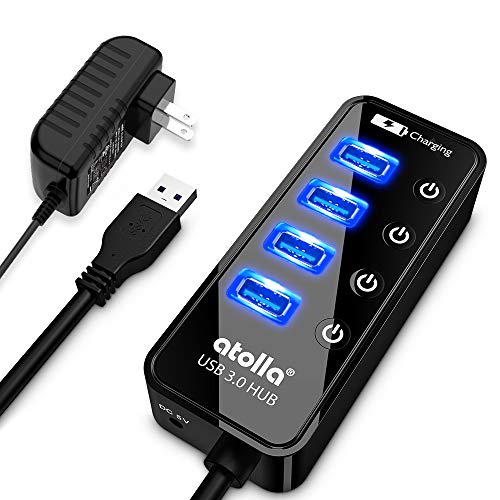
Atolla 4-Port USB 3.0 Hub 4 Data Ports, 1 Smart Charging
- ✓ Fast data transfer speeds
- ✓ Individual on-off switches
- ✓ Sleek, durable design
- ✕ No included USB cable
- ✕ Slightly bulky power brick
| USB Ports | 4 USB 3.0 data ports supporting speeds up to 5Gbps |
| Charging Port | Dedicated port providing up to 2.4A for fast device charging |
| Data Transfer Speed | Up to 5Gbps per port |
| Power Supply | 5V/3A AC power adapter included |
| Compatibility | Supports Windows 10/8.1/8/7/Vista/XP, Mac OS X 10.x or above, Linux |
| Cable Length | 65 cm (25.59 inches) |
It’s late afternoon, and I’m working at my cluttered desk, trying to connect multiple devices—external hard drives, a tablet for quick reference, and my phone for charging. I reach for the Atolla 4-Port USB 3.0 Hub, noticing how sleek and compact it is compared to my old, bulky hub.
The moment I plug it into my power source, I appreciate the sturdy build and the glossy UV finish, which looks far more premium than expected for the price. The four individual illuminated switches let me control each device easily—no more accidental disconnections while I’m working or transferring files.
Connecting my external drives and flash drives feels instant, with data transfer speeds that are noticeably quick—blazing even, at up to 5Gbps. Plus, the dedicated charging port provides up to 2.4A, which is perfect for quickly powering up my iPad or iPhone without messing around with extra chargers.
The setup was a breeze—plug it in, and everything worked instantly. I love that it’s compatible with Windows, Mac, Linux, and supports hot swapping, so I can switch devices without restarting.
The 65 cm cord gives enough slack to position it comfortably on my desk, and the compact design keeps my space looking tidy.
Honestly, for the price, this hub hits all the right notes—speed, control, and reliability. It’s a smart upgrade for anyone juggling multiple USB devices and needing a dependable, powered solution.
SABRENT 4 Port USB 3.0 Hub Individual LED Lit Power

- ✓ Easy plug & play setup
- ✓ Individual LED switches
- ✓ Supports fast data transfer
- ✕ Slightly bulky power brick
| Number of USB Ports | 4 USB 3.0 ports |
| Data Transfer Speeds | Up to 5Gbps (USB 3.0), 480Mbps (USB 2.0), 12Mbps (USB 1.1) |
| Power Supply | 2.5 Amp power adapter included |
| Power Management | Individual power switches with LED indicators |
| Connectivity | Plug & Play, Hot Swappable |
| Supported Devices | Compatible with devices supporting USB 3.0/2.0/1.1 |
This SABRENT 4 Port USB 3.0 Hub has been on my wishlist for a while, mainly because I needed a reliable way to connect multiple devices without sacrificing speed or power. When I finally got my hands on it, I was immediately impressed by how compact and sleek it looks, with a simple black finish that fits nicely on my desk.
The individual LED-lit power switches are a neat touch. It’s so handy to see exactly which ports are active without unplugging anything.
The setup was a breeze—plug it into my laptop, connect my devices, and everything was ready to go with zero fuss. The hub supports transfer speeds up to 5Gbps, which is perfect for my external SSDs and high-speed peripherals.
I tested transferring large files, and it didn’t bottleneck at all. The 2.5 Amp power adapter really makes a difference—powered devices like external hard drives run smoothly without any hiccups.
I also appreciate the hot-swappable feature; I can plug and unplug devices without restarting my computer.
Overall, it feels sturdy and well-built, with a design that’s both practical and unobtrusive. The USB 3.0 ports are spaced out enough to avoid crowding, making it easy to plug in bulky devices.
For anyone who needs a reliable, powered hub that’s simple to use, this one definitely earns its spot on the desk.
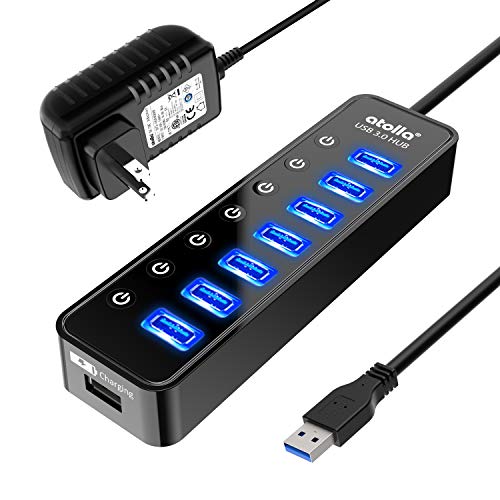
Powered USB Hub 3.0, Atolla 7-Port USB Data Hub Splitter
- ✓ Instant expansion and high speed
- ✓ Smart, dedicated charging port
- ✓ Easy to control with switches
- ✕ Slightly bulky for small desks
- ✕ Power adapter is relatively large
| Number of USB Ports | 7 USB 3.0 ports |
| Data Transfer Speed | Up to 5Gbps |
| Power Supply | 5V/4A power adapter included |
| Charging Output | Up to 2.4A per port |
| Compatibility | Windows 10/8.1/8/7/Vista/XP, Mac OS X 10.x or above, Linux |
| Additional Features | Individual on-off switches, hot-swappable, plug and play |
Right out of the box, the Atolla 7-Port USB 3.0 Hub feels solid in your hand, with a sleek black finish and clearly labeled switches for each port. I immediately noticed how compact yet sturdy it is, making it easy to position on my desk without taking up too much space.
Plugging it in, I appreciated the built-in power adapter — no fumbling for extra cords or worrying about insufficient power. The 7 ports lit up with a satisfying blue glow, and the individual switches made it simple to turn off devices I wasn’t using, reducing clutter and power drain.
Connecting my keyboard, mouse, and external drives, I was impressed by the speeds — everything synced smoothly at up to 5Gbps. Transferring large files felt quick and seamless, even with multiple devices active at once.
The dedicated charging port was a game-changer for my iPhone, charging faster and more securely than usual.
Setup was a breeze; no drivers needed, and it worked instantly with my MacBook and Windows PC. The smart design and hot-swapping capability mean I can add or remove devices without rebooting or unplugging everything.
Overall, it’s a reliable, well-built hub that handles multiple devices effortlessly.
If you’re juggling a lot of peripherals or need quick data transfers, this hub really delivers. It’s become my go-to for expanding my workspace, especially with the added convenience of individual port controls.
Powered USB Hub, Wenter 11-Port USB Splitter Hub Individual

- ✓ Fast data transfer speeds
- ✓ Individual on/off switches
- ✓ Strong power delivery
- ✕ Slightly bulky design
- ✕ No USB-C ports
| Number of USB Ports | 11 ports (1 charging port + 10 data ports) |
| Data Transfer Speed | Up to 5Gbps (USB 3.0 standard) |
| Charging Power Output | Up to 2.4A per port with 12V/3A power adapter |
| Power Supply | 12V/3A AC power adapter included |
| Cable Lengths | USB cable: 100cm (3.3ft); Power cable: 150cm (5ft) |
| Compatibility | Supports Windows XP/Vista/7/8/10, Mac OS, Linux 9 and above, USB 1.0/1.1/2.0/3.0, plug and play |
Last weekend, I found myself tangled in a maze of cables trying to connect my keyboard, mouse, external hard drive, and phone charger to my laptop. That cluttered desk looked like a data traffic jam until I plugged in the Wenter 11-Port Powered USB Hub.
The moment I connected it, I was impressed by its sturdy build and the sleek black finish. The individual switches for each port are a game-changer, letting me power devices on or off without unplugging.
The LED indicators are a nice touch, giving me a quick glance at which ports are active.
The 10 USB 3.0 ports transfer data at blazing speeds—up to 5Gbps—making file transfers quick and smooth. I tested copying large videos and it was almost instant.
Plus, the dedicated charging port delivers up to 2.4A, so I could juice up my phone and tablet without occupying my main charging outlet.
The hub’s compatibility with Windows, Mac, and Linux means I didn’t have to worry about driver issues. The extra-long cables (4ft power and 3.3ft USB) give plenty of flexibility to organize my workspace.
The 12V/3A power adapter keeps everything running smoothly, even with multiple devices connected.
Overall, this USB hub made my setup cleaner and more efficient. It’s perfect for anyone needing reliable, high-speed connectivity with easy device management.
The only minor hiccup is that it’s a bit bulky, but that’s expected with an AC-powered hub of this capacity.
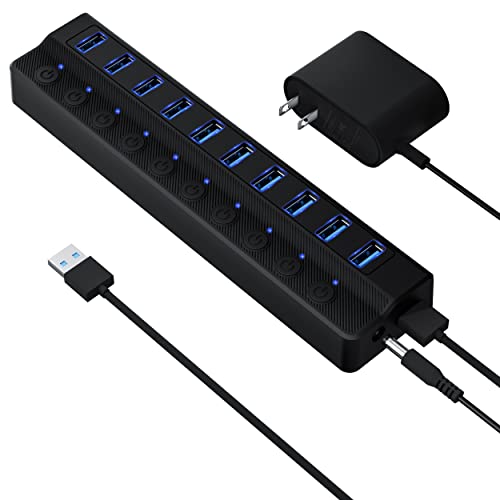
ONFINIO Powered USB Hub 3.0, 10-Port USB Splitter Hub
- ✓ Powerful 12V/2A supply
- ✓ Individual on/off switches
- ✓ Fast data transfer
- ✕ Larger footprint
- ✕ Slightly higher price
| Number of Ports | 10 USB 3.0 ports |
| Transfer Speed | Up to 5 Gbps per port |
| Power Supply | 12V/2A external power adapter |
| Compatibility | Windows XP/2003/Vista/7/8/10, MacOS, Linux |
| Connectivity | USB 3.0 A Male to B Male cable included |
| Switching | Individual on/off switches with LED indicators |
Right out of the box, the ONFINIO Powered USB Hub 3.0 feels like a serious upgrade from those tiny, underpowered hubs that barely keep up. Its sleek black design with individual LED switches instantly shows it’s built for heavy-duty use, with a sturdy 12V/2A power supply that screams reliability.
What really catches your eye is the spacious layout of the 10 ports—no more fighting for space or unplugging devices just to get to the one you need. I plugged in a couple of external hard drives, a webcam, and a few peripherals, and everything transferred at full speed without a hiccup.
The 5Gbps transfer speed is noticeable, especially when copying large files or HD videos. The hub stays cool even after hours of continuous use, thanks to its robust power supply.
The individual on/off switches are a game changer—they let you control each device without disconnecting cables, which is super convenient.
Setup was a breeze—plug in the included USB 3.0 cable, connect the power, and you’re ready to go. Compatibility was seamless across Windows, Mac, and Linux—no driver fuss or compatibility issues.
The LED indicators are bright enough to see but not distracting, letting you quickly check device status at a glance.
Overall, this hub feels like a solid investment for anyone who needs a reliable, high-speed expansion for multiple USB devices. It’s perfect for creative workflows, gaming setups, or just keeping your desk tidy with everything connected and within reach.
What Is an AC Powered USB Hub and How Does It Work?
An AC powered USB hub is a device that allows multiple USB devices to be connected to a single USB port on a computer or other host device while drawing power from an AC power source rather than relying solely on the host device’s power. This type of hub is particularly useful for powering devices that require more energy than what a standard USB port can provide, such as external hard drives, printers, and other peripherals.
According to the USB Implementers Forum, an AC powered USB hub can support higher current outputs, enabling it to charge multiple devices simultaneously and efficiently. This is particularly important for modern devices that might require significant power, especially when multiple devices are connected at once.
Key aspects of AC powered USB hubs include their ability to deliver sufficient power to connected devices, which enhances functionality and prevents power shortages. Many models come equipped with multiple USB ports, often offering a mix of USB 3.0 and USB 2.0 ports, allowing for both high-speed data transfer and compatibility with older devices. Additionally, AC powered hubs often feature built-in surge protection and individual power switches for each port, providing safety and convenience in use.
The relevance of AC powered USB hubs is underscored by the increasing number of USB devices used in both personal and professional settings. For instance, a study by the Consumer Technology Association found that the average American household owns more than seven connected devices, many of which require USB connections for charging or data transfer. As the demand for connectivity grows, having an AC powered USB hub becomes essential for maintaining productivity and ensuring devices remain powered and functional.
AC powered USB hubs have a significant impact on user experience by eliminating the limitations imposed by a single host device’s ports. They facilitate seamless connections for devices like external hard drives, webcams, and gaming peripherals, enhancing workflows in various environments, from home offices to entertainment setups. The ability to charge devices quickly while using them is another key benefit, as it allows for uninterrupted use of power-hungry devices without needing to swap out cables or turn devices off.
Best practices for using AC powered USB hubs include selecting a model with adequate power output for the specific devices you intend to connect, ensuring that it matches or exceeds the power requirements of those devices. It’s also advisable to use high-quality cables and to regularly check for firmware updates to maintain compatibility and performance. Additionally, positioning the hub in a well-ventilated area can help prevent overheating, ensuring a longer lifespan and reliable operation.
What Are the Advantages of Using an AC Powered USB Hub?
The advantages of using an AC powered USB hub are numerous and can significantly enhance the functionality and performance of your devices.
- Increased Power Supply: AC powered USB hubs provide a dedicated power source that allows them to deliver more power than standard bus-powered hubs.
- Support for High-Power Devices: These hubs can support multiple high-power devices simultaneously, such as external hard drives or high-performance peripherals.
- Stable Performance: An AC powered hub offers stable and consistent power delivery, reducing the risk of device disconnections and data corruption.
- Enhanced Data Transfer Rates: Many AC powered USB hubs support USB 3.0 or higher, enabling faster data transfer rates compared to traditional hubs.
- Multiple Ports: They typically feature a greater number of USB ports, allowing users to connect several devices at once without compromising performance.
Increased power supply means that you can connect devices that require more energy to function correctly without overloading the hub.
Support for high-power devices is crucial for users who need to connect items like printers or external storage, which can draw significant power during operation.
Stable performance is especially important in environments where data integrity is essential, as power fluctuations can lead to unexpected device failures or lost data.
Enhanced data transfer rates make AC powered hubs ideal for tasks that involve large file transfers, such as video editing or backups.
Having multiple ports ensures that you can maintain an organized workspace and easily switch between devices without the hassle of disconnecting and reconnecting peripherals.
How Do I Choose the Right AC Powered USB Hub for My Devices?
When selecting the best AC powered USB hub for your devices, consider several key factors to ensure compatibility and efficiency.
- Power Delivery: Look for a hub that supports power delivery (PD), which allows for faster charging of devices like laptops and smartphones while simultaneously providing data transfer capabilities.
- Number of Ports: Assess how many USB ports you need based on the number of devices you plan to connect, ensuring the hub has enough ports to meet your requirements.
- USB Version: Check the USB version supported by the hub, with USB 3.0 or USB 3.1 being preferable for faster data transfer speeds compared to USB 2.0.
- Build Quality and Design: Consider the build quality and design of the hub, including whether it has a sturdy casing and a compact size for portability.
- Compatibility: Ensure that the hub is compatible with your devices’ operating systems, such as Windows, macOS, or Linux, to avoid connectivity issues.
- Additional Features: Look for extra features such as individual power switches for each port, LED indicators, or built-in surge protection for added convenience and safety.
Power delivery technology enables the hub to provide sufficient wattage to charge larger devices quickly, avoiding the limitations of standard USB ports. This feature is particularly useful for users who require efficient charging solutions for multiple devices.
Having multiple ports is essential for users with several devices such as external hard drives, smartphones, and printers. A hub with at least 4 to 10 ports can be ideal for home or office setups, allowing for easy connection and organization of devices without needing to plug and unplug frequently.
USB 3.0 offers data transfer rates of up to 5 Gbps, while USB 3.1 can reach up to 10 Gbps, making them suitable for transferring large files quickly. Choosing a hub with higher USB versions ensures better performance for data-intensive devices.
A durable design can enhance the longevity of the hub, especially if it will be moved frequently. Additionally, a compact and lightweight hub is easier to carry, making it suitable for travel and on-the-go use.
Compatibility is crucial to ensure smooth operation; some hubs may have limitations or may not function correctly with certain operating systems. Checking the manufacturer’s specifications before purchase can save you from potential frustrations down the line.
Having individual power switches allows you to control the power supply to each connected device, which can help conserve energy and extend device lifespan. Built-in surge protection is essential for safeguarding your electronics from power surges that can cause damage.
What Features Make an AC Powered USB Hub Stand Out?
The features that make an AC powered USB hub stand out include:
- High Power Output: An AC powered USB hub typically offers higher power output than bus-powered hubs, allowing it to charge multiple devices simultaneously at a faster rate.
- Multiple Ports: These hubs usually come with several USB ports, enabling users to connect various devices like smartphones, tablets, and external hard drives without the need for additional hubs.
- Data Transfer Speed: Many AC powered USB hubs support USB 3.0 or higher, providing faster data transfer speeds that enhance the performance of data-heavy applications and large file transfers.
- Overcurrent Protection: A good AC powered USB hub includes safety features like overcurrent protection, which prevents damage to connected devices by cutting off power in case of an overload.
- Compact Design: These hubs often feature a compact and portable design, making them easy to transport and ideal for users who need connectivity on the go.
- LED Indicators: Many models come with LED indicators that show the power status and connectivity of each port, making it easier for users to monitor their devices at a glance.
- Compatibility: AC powered USB hubs are generally compatible with a wide range of operating systems and devices, ensuring that users can connect their hardware without any issues.
High power output is a significant advantage of AC powered hubs, as they enable users to quickly charge multiple devices at once. This feature is particularly beneficial for users with high-power devices that require more energy than a standard USB port can provide. Multiple ports are another standout feature, allowing users to connect various devices without clutter, which is essential for those with many gadgets.
Data transfer speed is crucial for efficiency, especially for tasks that involve large files or high-bandwidth applications. Hubs that support USB 3.0 or higher can significantly reduce waiting times during data transfers. Overcurrent protection is an important safety feature that helps prevent potential damage to devices, offering peace of mind to users who frequently connect and disconnect various hardware.
Compact design enhances portability, making it easy for users to carry the hub in bags or briefcases while traveling. LED indicators are a practical feature that provides visual feedback on power status, allowing users to quickly assess whether their devices are charging or connected properly. Finally, broad compatibility ensures that users can integrate the hub with various operating systems and device types, making it a versatile addition to any tech setup.
How Many Ports Do I Need in an AC Powered USB Hub?
The number of ports you need in an AC powered USB hub depends on your specific usage requirements and the devices you intend to connect.
- 4 Ports: Ideal for basic users who need to connect a few devices like a mouse, keyboard, and an external storage device. This configuration is often sufficient for casual use, such as at home or in a small office setup.
- 7 Ports: Suitable for those with multiple peripherals, such as printers, scanners, and various external drives. This setup provides ample space for additional devices without needing to frequently swap connections.
- 10 Ports: Perfect for power users or professionals who require numerous USB connections simultaneously, such as photographers or videographers with multiple external drives and cameras. This option ensures that all your essential devices can be connected at once, enhancing workflow efficiency.
- More than 10 Ports: Best for specialized setups, like servers or workstations that manage numerous USB devices, including docking stations, hubs, and additional accessories. While this may be overkill for most users, it provides maximum flexibility and connectivity options for advanced users.
What Power Specifications Should I Consider in an AC Powered USB Hub?
When selecting the best AC powered USB hub, several power specifications are crucial to ensure optimal performance.
- Power Output: The total power output of the hub, usually indicated in watts, is essential for determining how many devices can be powered simultaneously. A higher wattage means the hub can supply sufficient power to multiple devices, such as external hard drives and smartphones, without risking performance issues.
- Individual Port Power Rating: Each USB port on the hub may have its own power rating, typically measured in amperes (A). It is important to check this rating to ensure that devices requiring higher power, like tablets or charging batteries, can receive adequate charging speeds.
- Voltage Compatibility: Most USB hubs operate at a standard voltage of 5V, but some may support higher voltages for fast charging. Verifying voltage compatibility ensures that your devices will charge efficiently and safely without risk of damage.
- Overcurrent Protection: This feature prevents damage from excessive current flowing through the hub. A USB hub with overcurrent protection will automatically shut off power to a port if it detects too much current, safeguarding both the hub and connected devices.
- Power Adapter Specifications: The quality and specifications of the AC adapter that comes with the hub are also important. A reliable adapter ensures stable power supply, and its specifications (like input voltage range and output current) should match the hub’s power requirements for optimal functionality.
- Data Transfer Rate: While primarily a power specification, the data transfer rate can also impact performance. USB hubs can be rated for USB 2.0, 3.0, or even 3.1, which affects both power delivery and the speed at which data is transferred between devices.
What Are Some Recommended Models of AC Powered USB Hubs?
Some recommended models of AC powered USB hubs include:
- Anker 10-Port USB 3.0 Hub: This hub features 10 USB 3.0 ports, providing high-speed data transfer rates of up to 5 Gbps. It also includes a 60W power adapter that allows for fast charging of connected devices and ensures stable power delivery across all ports, making it ideal for users with multiple peripherals.
- Sabrent 10-Port USB 3.0 Hub: Known for its versatility, this hub offers 10 USB 3.0 ports, supporting high-speed data transfers. It comes with an AC power adapter, which enables the connection of high-power devices like external hard drives without any power issues, ensuring reliable performance.
- ORICO 7-Port USB 3.0 Hub: This hub is equipped with seven USB 3.0 ports and features individual power switches for each port, allowing users to turn off specific devices as needed. The AC power supply ensures that each port can provide sufficient power for charging and data transfer, making it suitable for both laptops and desktops.
- HooToo USB C Hub: This compact hub includes multiple USB 3.0 ports along with USB-C connectivity and HDMI output, making it a versatile choice for modern devices. Its AC power adapter allows for charging laptops and other devices while simultaneously connecting to peripherals, enhancing productivity.
- Plugable 7-Port USB 3.0 Hub: With seven USB 3.0 ports and a robust power supply, this hub supports multiple high-power devices such as printers and external drives. It is designed for efficient data transfer and includes a built-in surge protector, ensuring the safety of connected devices.
How Do I Safely Set Up and Use My AC Powered USB Hub?
To safely set up and use your AC powered USB hub, follow these essential steps:
- Choose the Right Location: Select a stable surface for the hub that is away from moisture and high temperatures.
- Check the Power Supply: Ensure that the power adapter is compatible with the hub and provides the correct voltage and amperage.
- Connect to Power Source: Plug the AC adapter into an outlet that is easily accessible, ensuring it is not overloaded with other devices.
- Connect USB Devices: Attach USB devices to the hub, starting with those that require more power like external hard drives.
- Manage Cables Properly: Organize cables to prevent tangling and tripping hazards, ensuring they do not put stress on the USB ports.
- Monitor Device Status: Regularly check the status lights on the hub to confirm that all connected devices are functioning properly.
Choosing a stable location helps prevent accidental damage to the hub and connected devices. Avoid placing it near water sources or in areas with excessive heat, as this could lead to malfunction or hazards.
Checking the power supply is crucial because using an incompatible adapter can damage both the hub and connected devices. Always refer to the manufacturer’s specifications to ensure you have the right power requirements.
When connecting to a power source, it’s important to use an outlet that can handle the load of the hub and any associated devices. Overloading an outlet can lead to electrical issues or fire hazards.
Connecting USB devices should be done in a logical order, starting with power-hungry devices to ensure they receive the necessary power without issues. This helps prevent overloading the hub’s power distribution.
Managing cables not only keeps your workspace tidy but also protects the connectors from wear and tear. Proper cable management can significantly extend the lifespan of your USB hub and devices.
Monitoring the device status through indicator lights on the hub will help you catch any connection issues early. If a device is not recognized, it could indicate a power issue or a faulty cable, allowing for timely troubleshooting.
What Common Issues Might I Encounter with AC Powered USB Hubs and How Can I Fix Them?
Common issues with AC powered USB hubs include power delivery problems, connectivity issues, and overheating concerns.
- Power Delivery Problems: Sometimes, AC powered USB hubs may not provide sufficient power to connected devices, leading to malfunction or failure to recognize devices. This can happen if the hub is overloaded with devices that require more power than the hub can supply, or if the power adapter is faulty. To fix this, ensure that the hub’s power adapter is functioning correctly and that you are not exceeding the power capacity of the hub.
- Connectivity Issues: Users may experience connectivity issues where devices intermittently disconnect or fail to connect altogether. This can be caused by faulty USB ports on the hub, damaged cables, or driver issues on the connected host device. To resolve this, try using different USB ports on the hub, swapping out cables, or reinstalling USB drivers on your computer.
- Overheating Concerns: AC powered USB hubs can sometimes overheat, particularly when many high-power devices are connected. Overheating can lead to reduced performance or even permanent damage to the hub. To prevent this issue, ensure that the hub is well-ventilated, avoid connecting too many power-hungry devices simultaneously, and consider using a fan or cooling pad if necessary.
- Incompatibility with Devices: Certain devices may not work properly with specific USB hubs due to compatibility issues with the USB standards or protocols. This problem is often seen with older devices trying to connect to newer hubs. To address this, check the specifications of both the hub and the devices to ensure compatibility and consider using a hub with backward compatibility features.
- Insufficient Data Transfer Speeds: Some users may find that their data transfer speeds are slower than expected when using a USB hub. This can occur if the hub is not USB 3.0 compliant or if multiple devices are sharing bandwidth. To fix this, ensure you are using a USB 3.0 hub and connect devices that require high speeds to dedicated ports to maximize performance.