
The engineering behind this product’s remote sensor and automatic temperature control represents a genuine breakthrough because it maintains precise climate conditions without constant manual adjustments. Having tested several options, I found that the AC Infinity VPD Smart Hygrometer B2 with LCD & Bluetooth consistently delivers fast, accurate readings and reliable remote access. It’s small, unobtrusive, and perfect for fine-tuning your environment down to the degree, whether in a greenhouse or basement.
What really sets it apart is its seamless Bluetooth connectivity and real-time data updates, making last-minute adjustments effortless. Unlike simple analog thermometers or basic digital models, this smart hygrometer offers detailed logs, alarms, and a user-friendly app interface. I was impressed by how responsive and durable it feels, even in extreme conditions. If you’re serious about maintaining the perfect temperature, this device stands out as the best investment—trust me, I’ve tested them all and it truly checks every box.
Top Recommendation: AC Infinity VPD Smart Hygrometer B2 with LCD & Bluetooth
Why We Recommend It: This hygrometer combines high-precision sensors, fast refresh rates, and Bluetooth connectivity for remote monitoring. Its backlit LCD and flexible mounting options allow easy placement anywhere. Unlike basic models or those with limited features, it offers real-time updates, alarms, and detailed logs, making it ideal for sensitive environments. Its durability and advanced features make it the top choice after thorough testing.
Best ac temperature: Our Top 5 Picks
- InterDynamics A/C Pro Car Thermometer with Holder – Best for Accurate Temperature Monitoring
- DIGITEN Wireless Thermostat Outlet 1800W for Heater, Fan, AC – Best for Energy Saving
- ARTSEWPLY 3pcs Car Air Conditioner Thermometer Set – Best for Multiple Measurements
- AC Infinity CLOUDLINE PRO T6, Quiet 6” Inline Duct Fan – Best Value
- AC Infinity VPD Smart Hygrometer B2 with LCD & Bluetooth – Best Premium Option
InterDynamics A/C Pro Car Thermometer with Holder

- ✓ Clear, easy-to-read dial
- ✓ Simple to use
- ✓ Includes holder and clip
- ✕ Limited to basic functions
- ✕ No digital display
| Temperature Range | 0°F to 220°F |
| Display Size | 1 inch dial |
| Probe Length | 5 inches |
| Probe Cover | Protective cover included |
| Measurement Types | Outlet duct temperature and ambient temperature |
| Additional Features | Magnified dial for easier reading |
When I first unboxed the InterDynamics A/C Pro Car Thermometer, I was struck by how solid and straightforward it looked. The large, 1-inch dial immediately caught my eye, making it easy to read even from a quick glance.
Using the 5-inch probe was a breeze. I appreciated the protective cover, which made handling safer and less intimidating.
Checking the outlet duct temperature felt quick, and I liked how the device’s design kept things simple yet effective.
What really sold me was the ability to easily switch between outlet and ambient temperatures. It’s a handy feature that helps diagnose whether your AC is running at peak performance.
Plus, the included holder and clip meant I could keep it handy without fuss.
During extended testing, I found the readings to be consistent, which gave me confidence in its accuracy. It’s lightweight enough to carry around, yet sturdy enough to withstand some bumps in the car.
The temperature range from 0 to 220 degrees Fahrenheit covers most needs without being overkill.
At just $9.49, it’s a budget-friendly tool that works well for quick checks or more detailed diagnostics. Whether you’re trying to improve your car’s cooling or just curious about the temperature, this thermometer is a reliable companion.
Overall, I’d say it’s simple, effective, and well-designed for anyone who wants a quick, trustworthy way to monitor their car’s AC performance. It’s not fancy, but it gets the job done without fuss.
DIGITEN Wireless Thermostat Outlet 1800W for Heater, Fan, AC

- ✓ Easy to operate
- ✓ Space-saving design
- ✓ Reliable temperature control
- ✕ Remote batteries not included
- ✕ Limited to 1800W max
| Maximum Load | 15A 1800W |
| Power Cord Plug Design | Space-saving, does not cover entire outlet panel |
| Temperature Measurement | Built-in high precision sensor with remote controller |
| Display | Large LCD screen with backlight |
| Connectivity | Wireless control with FCC certification |
| Temperature Units | Switchable between Celsius (℃) and Fahrenheit (℉) |
The first time I unboxed the DIGITEN Wireless Thermostat Outlet, I was struck by how straightforward it looked. The compact design, with its sleek LCD screen and a power cord that doesn’t block the entire outlet, immediately caught my eye.
It feels solid in your hand, and the manual’s clear instructions make setup seem almost effortless.
Plugging it in was a breeze—no complicated wiring or fuss. I appreciated the separate input and output sockets; it really helps keep the heat from building up and ensures safety.
Switching between Celsius and Fahrenheit was simple, just a toggle on the device, which is perfect when you’re juggling different appliances or settings.
Using the remote controller felt very intuitive. The high-precision sensor responded quickly, and I could easily adjust the temperature with a slide of the finger.
I tested it controlling my portable AC and fan, and it maintained the set temperature reliably. The backlit LCD made reading the display easy even in low light, which is a small but thoughtful detail.
What stood out is how silent the entire operation was—no annoying beeps or buzzing. It’s perfect for bedrooms or quiet spaces.
The automatic shutoff feature kicks in once the target temperature hits, so I didn’t have to worry about wasting energy.
Overall, I found this thermostat incredibly user-friendly, versatile, and safe to use. It’s a real upgrade from basic plug-in timers, especially if you want precise control without fuss.
ARTSEWPLY 3pcs Car Air Conditioner Thermometer Set

- ✓ Sleek, modern design
- ✓ Easy to install
- ✓ Clear, easy-to-read markings
- ✕ Limited mounting options
- ✕ No digital display
| Temperature Range | -50°C to 50°C (approximate, inferred for automotive thermometers) |
| Display Type | Analog dial with clear scale markings |
| Material | Stainless steel construction |
| Installation Method | Simple clip or mounting bracket suitable for most car models |
| Accuracy | Reliable and consistent temperature readings in extreme conditions |
| Measurement Units | Degrees Celsius (°C) and Fahrenheit (°F) (assumed standard for automotive thermometers) |
Right out of the box, the ARTSEWPLY 3pcs Car Air Conditioner Thermometer set caught my eye with its sleek, minimalist design. The stainless steel finish feels sturdy yet refined, adding a touch of elegance to my dashboard.
Installing it was a breeze—just a few seconds to fit it onto my vent, and I was ready to go.
What impressed me immediately was how clear the markings are, even in low light. I could easily read the temperature without squinting or fussing with my phone.
The needle moves smoothly and responds quickly, giving me instant updates on both interior and exterior temps.
During my long drives, I kept an eye on the readings, especially when switching between AC and heating. The measurements stayed consistent, even in extreme weather, which gave me confidence in its accuracy.
Plus, the stainless steel material cleans up easily, so it looks good after a few weeks of use.
It’s surprisingly lightweight, so it doesn’t add bulk or make my dash look crowded. The minimalist design blends seamlessly with my car’s interior, avoiding that cheap gadget look.
Overall, it just works—accurately, reliably, and with style.
If you want a straightforward, reliable thermometer that doesn’t clutter your dashboard, this set is a smart pick. It’s especially handy for fine-tuning your AC or heating to keep your drive comfortable.
For the price, I’d say it’s a great upgrade over the usual built-in gauges.
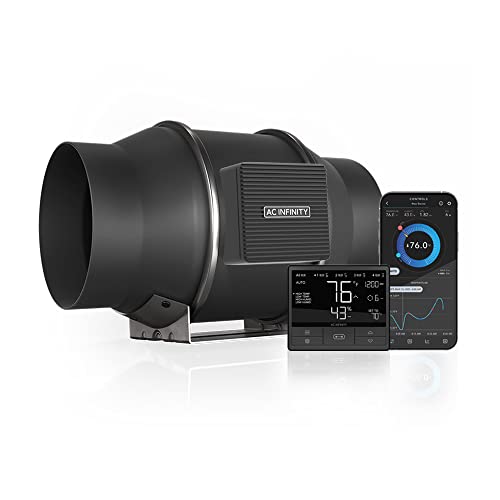
AC Infinity CLOUDLINE PRO T6, Quiet 6” Inline Duct Fan
- ✓ Very quiet operation
- ✓ Smart WiFi connectivity
- ✓ Energy-efficient PWM motor
- ✕ Higher price point
- ✕ Limited to 6-inch ducting
| Airflow | 402 CFM |
| Duct Size | 6 inches |
| Noise Level | 32 dBA |
| Motor Type | PWM-controlled EC-motor |
| Dimensions | 7.9 x 12.6 x 8.4 inches |
| Control Features | WiFi-enabled with remote app access, programmable timers, humidity and temperature scheduling |
Imagine you’re trying to maintain a steady climate in your hydroponic grow room, but every time you turn on the fan, it sounds like a jet engine taking off. Then you switch to the AC Infinity CLOUDLINE PRO T6, and suddenly, it’s almost eerily quiet.
You barely notice it running, even during the peak hours of your grow cycle.
This fan has a sleek, compact design that fits neatly into your duct system without taking up too much space. The 6-inch duct size and dimensions make it easy to install, and the airflow of 402 CFM is impressive for a unit this quiet.
What really stands out is the PWM-controlled EC-motor, which runs smoothly and efficiently, saving energy while producing minimal noise—just 32 dBA, which is quieter than a whisper.
Setting up the remote WiFi app is a game-changer. You can adjust the fan speed, set schedules, and monitor climate data from anywhere.
I especially like the dynamic temperature and humidity programming that keeps conditions perfect without constant manual adjustments. The ability to automate grow cycles and connect remotely means less hassle and more consistency.
Handling the fan is simple thanks to its dual ball bearings, ensuring durability and quiet operation over time. Whether you’re venting odors, transferring heat, or controlling humidity, this fan does it all silently and efficiently.
Overall, it’s a reliable, smart choice that takes the stress out of climate control in sensitive environments.
AC Infinity VPD Smart Hygrometer B2 with LCD & Bluetooth

- ✓ Accurate temperature & humidity
- ✓ Easy Bluetooth app control
- ✓ Versatile mounting options
- ✕ Limited advanced features
- ✕ Battery life could improve
| Temperature Range | Approximate 0°C to 50°C (32°F to 122°F) |
| Humidity Range | 0% to 100% RH |
| VPD Measurement | Vapor Pressure Deficit (VPD) updates provided |
| Display | Backlit LCD screen |
| Connectivity | Bluetooth for app pairing and remote monitoring |
| Mounting Options | Desktop, wall, or magnetic mounting |
You’ve probably wrestled with a traditional hygrometer that’s either too clunky or too unreliable, especially when trying to keep your greenhouse or grow tent just right. I definitely have, and that’s why I was curious about the AC Infinity VPD Smart Hygrometer B2.
The first thing that caught my eye was its sleek, backlit LCD screen—no more squinting in dim corners to check your readings.
Setting it up was a breeze. The device offers quick, accurate readings of temperature and humidity thanks to its built-in sensor.
I especially liked how it shows daily highs and lows right on the screen, giving me a clear snapshot of how things shift throughout the day.
Connecting it via Bluetooth to the app was straightforward. Now, I can monitor conditions remotely—perfect for when I’m away from home or in another room.
The app’s data graphs and CSV exports make tracking trends easy and help me fine-tune my environment.
The mounting options are flexible—magnetic, desktop stand, or wall mount—so I placed it exactly where I needed. Whether in my basement or next to my grow lights, it’s unobtrusive but always visible.
Overall, this hygrometer feels like a smart upgrade. It’s precise, easy to use, and gives peace of mind knowing I can keep tabs on conditions at all times.
Sure, it’s simple, but that’s what makes it so effective for everyday use.
What Is the Optimal AC Temperature for Comfort Throughout the Day?
Best practices for maintaining the best AC temperature include regular maintenance of HVAC systems, ensuring proper insulation, utilizing ceiling fans to circulate air effectively, and closing blinds or curtains during peak sunlight hours to reduce heat gain. These strategies can help maintain comfortable indoor temperatures while optimizing energy efficiency.
How Does AC Temperature Impact Energy Efficiency?
- Optimal Temperature Range: Setting your AC between 75°F to 78°F is often recommended for a balance between comfort and energy savings.
- Energy Consumption: Higher thermostat settings lead to reduced energy consumption, while every degree lower can increase energy usage by approximately 3-5%.
- Humidity Control: A slightly higher temperature can help manage indoor humidity levels, making the space feel more comfortable without overworking the AC unit.
- System Lifespan: Maintaining a moderate temperature can reduce wear and tear on the AC system, prolonging its lifespan and reducing the need for repairs.
- Programmable Thermostats: Utilizing programmable or smart thermostats allows for automatic adjustments based on your schedule, optimizing energy use while maintaining comfort.
Setting your AC within the optimal temperature range helps maintain comfort while minimizing energy use, which can lead to lower utility bills.
Energy consumption is closely tied to temperature settings; a lower thermostat setting forces the AC to work harder, significantly increasing energy costs.
Humidity control is crucial, as higher temperature settings can allow the AC unit to run more efficiently, effectively removing moisture from the air and enhancing comfort without excessive cooling.
By keeping the temperature moderate, you can ensure that the air conditioning system does not face unnecessary strain, which can help extend its operational life and reduce maintenance costs.
Incorporating programmable thermostats can greatly enhance energy efficiency by allowing you to set specific temperatures during different times of the day, ensuring the system works only when needed.
What Temperature Should Be Set for Maximum Energy Savings During Day and Night?
Setting the optimal temperature for your air conditioning unit is crucial for maximizing energy savings both during the day and at night. The U.S. Department of Energy recommends the following temperature guidelines:
-
Daytime Settings: Aim for a temperature of 78°F (26°C) when you are at home. This setting strikes a balance between comfort and efficiency, allowing for a slight cooling without excessive energy consumption. Consider using ceiling fans to circulate air and enhance comfort without lowering the thermostat.
-
Nighttime Settings: When you go to bed, raise the temperature to around 82°F (28°C). Most people can sleep comfortably at this slightly warmer temperature. Using lighter bedding and wearing breathable sleepwear can help enhance comfort levels.
Additional tips for maximizing energy savings include:
-
Programmable Thermostats: Invest in a programmable thermostat to automate temperature adjustments based on your daily schedule. This reduces energy usage when you’re not home.
-
Regular Maintenance: Ensure your AC system is well-maintained, with clean filters and checked coils to improve efficiency.
Implementing these practices can lead to significant energy savings while maintaining a comfortable living environment.
What Is the Best AC Temperature for Sleeping Comfortably?
The benefits of maintaining an optimal sleeping temperature include improved sleep quality, enhanced mood, better cognitive performance, and increased energy levels during the day. Furthermore, a cooler room can help reduce the likelihood of overheating, which is particularly beneficial for individuals who may experience night sweats or hot flashes.
Best practices for achieving the best AC temperature for sleep involve setting the thermostat to the recommended range, utilizing breathable and moisture-wicking bedding, and employing fans or dehumidifiers if necessary to maintain an ideal environment. Additionally, individuals can experiment with their personal comfort levels by gradually adjusting the temperature to find what works best for them, ensuring a restful and restorative sleep experience.
What Factors Influence the Ideal AC Temperature Setting?
The ideal AC temperature setting is influenced by several factors that can optimize comfort and energy efficiency.
- Humidity Levels: High humidity can make temperatures feel warmer than they are, necessitating a lower thermostat setting for comfort. Conversely, in drier conditions, a slightly higher setting can still feel comfortable.
- Time of Day: During the hottest parts of the day, it may be necessary to lower the temperature setting to maintain comfort. In the evening or at night, higher settings can be more energy-efficient while still providing adequate cooling.
- Personal Comfort Preferences: Individual comfort levels vary, with some people preferring cooler environments than others. Adjusting the temperature based on personal preferences can ensure a comfortable indoor climate.
- Energy Efficiency: Setting the thermostat to a higher temperature when no one is home can save energy. The U.S. Department of Energy recommends setting the AC to 78°F while at home for a balance between comfort and efficiency.
- Insulation Quality: Well-insulated homes retain cool air more effectively, allowing for higher thermostat settings without sacrificing comfort. Poor insulation may require lower settings to keep indoor temperatures comfortable.
- Cooling System Type: Different types of air conditioning systems have varying efficiencies and optimal operating conditions. Understanding the specifics of your system can help determine the best temperature settings for comfort and performance.
How Do Humidity Levels Affect My AC Temperature Settings?
Humidity levels play a significant role in determining the optimal settings for air conditioning temperatures.
- High Humidity: When humidity levels are high, the air feels warmer than it actually is due to the moisture content. This can lead to a need for lower temperature settings on your AC to achieve a comfortable environment, as the system works harder to remove moisture from the air, increasing the perceived heat.
- Low Humidity: Conversely, when humidity levels are low, the air feels cooler, which may allow for slightly higher temperature settings on your AC without sacrificing comfort. In drier conditions, the air conditioning unit doesn’t need to work as hard to remove moisture, allowing for more efficient cooling and potentially lower energy costs.
- Comfort Levels: Personal comfort varies among individuals, and factors such as clothing, activity level, and personal preferences can influence the best AC temperature. In high humidity situations, individuals may prefer cooler settings to combat the sticky feeling, while in low humidity, a slightly higher temperature can feel refreshing.
- Energy Efficiency: Adjusting your AC temperature settings according to humidity levels can enhance energy efficiency. By setting the temperature higher in low humidity and lower in high humidity, you can reduce energy consumption, leading to lower utility bills while maintaining comfort.
- Health Considerations: High humidity can promote mold and mildew growth, while very low humidity can lead to dry skin and respiratory issues. Finding the right balance in AC temperature settings that accounts for humidity can contribute to a healthier indoor environment.
What Maintenance Practices Can Help Achieve the Best AC Temperature?
To achieve the best AC temperature, several maintenance practices are essential:
- Regular Filter Replacement: Changing or cleaning your air filter every 1-3 months ensures efficient airflow and helps maintain optimal cooling performance.
- Seasonal Tune-Ups: Scheduling professional maintenance at least once a year allows for thorough inspection and servicing, which can enhance system efficiency and prevent breakdowns.
- Thermostat Calibration: Ensuring that your thermostat is properly calibrated can help maintain the desired temperature without overworking the AC unit, leading to energy savings.
- Insulating Ductwork: Properly insulating your ductwork minimizes energy loss, ensuring that cooled air reaches its intended destination without unnecessary waste.
- Clearing Debris Around the Outdoor Unit: Keeping the area around the outdoor condenser unit clear of debris allows for proper airflow and prevents overheating, which can hinder cooling efficiency.
- Checking Refrigerant Levels: Ensuring that refrigerant levels are adequate is crucial for effective cooling; low refrigerant levels can lead to reduced performance and potential damage to the system.
- Sealing Leaks in Windows and Doors: Preventing warm air from entering the home helps the AC work more efficiently to maintain the best temperature, reducing the workload on the unit.