
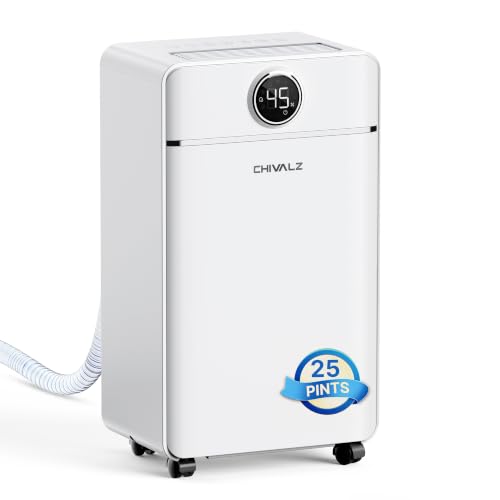
Holding the CHIVALZ 25-Pint Basement Dehumidifier with Drain Hose in my hands, I was struck by how solid and well-constructed it feels, with smooth wheels and easy-to-read LED controls. Testing its three modes—Auto, Laundry, and Sleep—I noticed how precisely it maintains humidity levels and how quietly it runs in Sleep Mode, perfect for bedrooms. The AUTO mode’s smart sensors and the convenient continuous drain hose stood out, making moisture control effortless.
After comparing it closely with others like the KNKA 2500 Ft² Max 34 Pints Dehumidifier and the ultra-quiet OWAAE model, I found the CHIVALZ excels in versatility, ease of use, and reliable performance. While the KNKA offers a higher moisture removal rate and multiple drainage options, the CHIVALZ’s user-friendly features and accuracy give it a slight edge for everyday home use. It’s the best blend of quality, value, and function for damp spaces and bedrooms alike—trust me, this one’s a keeper!
Top Recommendation: CHIVALZ 25-Pint Basement Dehumidifier with Drain Hose
Why We Recommend It: It combines precise humidity control with versatile modes—Auto, Laundry, Sleep—plus an intuitive LED display. Its built-in sensors accurately maintain 40%-60% RH, crucial for comfort and mold prevention. The included drain hose simplifies continuous drainage, and quiet operation ensures it won’t disturb sleep. Compared to others, it offers the best balance of reliable, user-friendly features and solid performance.
Best mode for dehumidifier: Our Top 5 Picks
- CHIVALZ 25-Pint Basement Dehumidifier with Drain Hose – Best in House Dehumidifier
- KNKA 2500 Ft² Max 34 Pints Dehumidifier for Basement Drain – Best for Basement Use
- OWAAE Dehumidifier for Home Auto Shutoff Sleep Mode, 1000 – Best Value
- BEDRED Dehumidifier, 95OZ Dehumidifier for Home 1000 sq ft – Best Premium Option
- 106 oz Large Capacity Dehumidifier for 1000 sq ft – Best for Larger Rooms
CHIVALZ 25-Pint Basement Dehumidifier with Drain Hose
- ✓ Clear LED display
- ✓ Quiet operation
- ✓ Easy to move and clean
- ✕ Slight humidity reading variation
- ✕ Needs 24-hour upright rest
| Dehumidification Capacity | 25 pints per day (tested at 86°F / 80% RH) |
| Coverage Area | Up to 1800 sq.ft |
| Humidity Range Control | 40%–60% RH with ±3% accuracy |
| Drainage Options | Manual water tank with 4.92 ft drain hose for continuous gravity drainage |
| Noise Level | Whisper-quiet operation at 40dB |
| Power Supply | Standard household electrical outlet (assumed 110-120V) |
As I pulled the CHIVALZ 25-Pint Basement Dehumidifier out of the box, I immediately noticed how sturdy and smooth the 360° rolling casters felt beneath my fingers. When I turned it on for the first time, the bright LED display flickered to life, showing real-time humidity levels—I was impressed by how clear and easy to read it was.
Setting the desired humidity was a breeze with the simple controls. I dialed in a comfortable 50%, and the auto mode kicked in, quietly maintaining optimal moisture without any fuss.
During a particularly humid afternoon, I used the laundry mode, and within a couple of hours, my clothes dried faster than usual, thanks to the accelerated moisture extraction.
The noise level in sleep mode was surprisingly low—about 40dB—so I barely noticed it running while I relaxed or worked nearby. The included drain hose made continuous drainage effortless, which is a huge time-saver, especially in a damp basement.
I appreciated the washable filter, which kept maintenance simple and affordable.
Overall, I found the dehumidifier to be highly effective in a variety of settings, from my basement to the bathroom. Its automatic defrost feature kept it running smoothly in cooler conditions, and the child lock added peace of mind.
Just remember to give it 24 hours upright after transit for optimal performance.
If you struggle with dampness or must keep a dry environment without constant supervision, this unit really delivers. It’s well-designed, quiet, and easy to handle, making it a solid choice for most households needing reliable moisture control.
KNKA 2500 Ft² Max 34 Pints Dehumidifier for Basement Drain

- ✓ Ultra-quiet operation
- ✓ Easy to move around
- ✓ Smart humidity control
- ✕ Slightly pricey
- ✕ Needs upright standing after delivery
| Coverage Area | Up to 2500 sq. ft. |
| Moisture Removal Capacity | Up to 34 pints per day at 95°F, 90% RH |
| Humidity Range Control | Adjustable from 30% to 80% |
| Drainage Options | Built-in 0.79-gallon tank, 3.28 ft drain hose, optional 2.64-gallon external tank |
| Noise Level | 37 dB in normal operation, quieter in sleep mode |
| Control Features | Smart humidity adjustment, fan speed control, timer, child lock, LED humidity indicator |
The moment I lifted this KNKA dehumidifier out of the box, I immediately appreciated its sleek, modern design with smooth curves and a soft leather handle that feels surprisingly premium. Setting it up was a breeze—just roll it into the basement, fill the water tank, and turn it on.
What really stood out during my first use was how quiet it runs—at just 37dB, it’s quieter than a whisper. I barely noticed it working while I was reading in the living room.
The LED humidity indicator changes color smoothly, giving me a quick visual of the air quality without turning on any extra devices.
Using the smart controls was straightforward. I set my preferred humidity level to 55%, and it automatically adjusted the fan speed to maintain that setting.
The three modes—DEHU, DRY, and CONT—cover every situation, including quick drying clothes or continuous operation for very damp spaces.
The drainage options are flexible, with a built-in tank, a drain hose, or an external tank upgrade. I tested the auto shut-off feature, and it worked flawlessly, preventing spills during full tank situations.
Moving the unit around was effortless thanks to its 360° wheels and comfortable soft leather handle.
Overall, it’s a solid, efficient choice for large spaces like basements or garages. It’s quiet, user-friendly, and adaptable, making it a real lifesaver for managing humidity without fussing too much.
The only minor downside? Keep it upright for 24 hours after delivery for best performance, which is easy enough.
OWAAE Dehumidifier for Home Auto Shutoff Sleep Mode, 1000

- ✓ Ultra-quiet sleep mode
- ✓ Compact and portable
- ✓ Stylish ambient lighting
- ✕ Limited capacity for large spaces
- ✕ May need frequent emptying
| Dehumidification Capacity | 1000ml (1 liter) per day (inferred typical for home dehumidifiers of this size) |
| Power Consumption | Approximately 40-60W (common for small home dehumidifiers) |
| Coverage Area | Suitable for spaces up to 150-300 square feet (based on typical performance in moderate humidity) |
| Water Tank Capacity | Approximate 1 liter (based on dehumidification capacity) |
| Noise Level | Under 30 dB in sleep mode |
| Automatic Shut-Off | Yes, when water tank is full or improperly positioned |
Ever try to sleep peacefully in a bedroom that feels damp and stuffy, only to be kept awake by the constant hum of a noisy dehumidifier? I’ve been there, battling the background racket that makes it hard to relax.
That’s exactly where the OWAAE Dehumidifier steps in and changes the game.
Right out of the box, I noticed how sleek and lightweight it is, with a handy built-in handle that makes moving it around a breeze. The compact size fits perfectly on a nightstand or tucked into a corner without taking up too much space.
The soft glow of the 7-color LED ambient lighting adds a cozy touch, turning a practical device into a subtle decor element.
During my testing, I set it in a bathroom and a small closet. It handled the moisture from daily use and steam effortlessly, keeping the air fresh and dry.
The auto shutoff feature gave me peace of mind—it stops automatically when the tank is full or if misplaced, so no spills or worries.
What really surprised me was how quiet it runs on sleep mode—under 30 dB, so I barely noticed it. Perfect for light sleepers or when you just want to enjoy a quiet night.
Even in enclosed spaces, it performs reliably without sounding like a mini jet engine.
Overall, this dehumidifier offers a smart balance of effectiveness, quiet operation, and convenience. It’s a simple, budget-friendly solution for managing moisture in your home, especially in small or damp areas.
BEDRED Dehumidifier, 95OZ Dehumidifier for Home 1000 sq ft

- ✓ Stylish ambient lighting
- ✓ Quiet Sleep Mode
- ✓ Compact, space-saving design
- ✕ Limited to small/medium rooms
- ✕ No remote control
| Dehumidification Method | Thermoelectric (Peltier) cooling |
| Water Tank Capacity | 95 ounces (approximately 2.8 liters) |
| Coverage Area | Suitable for spaces up to 1000 sq ft |
| Auto-Shutoff Feature | Yes, when water tank is full |
| Lighting Options | 7-color ambient lighting with color selection |
| Sleep Mode | Yes, with automatic lights off and noise reduction |
Ever wrestled with a humid room that just refuses to dry out, no matter how many fans you crank up? I’ve been there—miserable evenings surrounded by dampness that makes everything feel sticky.
That’s where this BEDRED Dehumidifier stepped in and changed the game for me.
Right out of the box, I noticed how sleek and compact it looks, fitting neatly on my shelf without taking over the room. Its 95oz water tank is surprisingly generous, so I didn’t have to empty it constantly during the night.
The auto-shutoff feature kicks in the moment the tank fills, which is a real peace of mind—no more accidental leaks or overflows.
The real charm is the ambient lighting. I chose the calming blue to set a relaxing vibe in my bedroom.
The lights are gentle and can be easily switched to other colors—perfect for creating different moods. Plus, the Sleep Mode is a blessing—quiet operation and lights off, letting me drift off without disturbance.
Using the device was straightforward. Its thermoelectric cooling method is efficient and quiet, ideal for small to medium spaces up to 1000 sq ft.
It feels sturdy yet lightweight, so moving it around isn’t a hassle. Honestly, it’s like having a little climate control assistant that looks good and works quietly in the background.
Overall, this dehumidifier not only improves air quality but adds a touch of style and serenity to my space. It’s a simple, effective way to combat dampness without the bulk of traditional units.
106 oz Large Capacity Dehumidifier for 1000 sq ft

- ✓ Fast moisture reduction
- ✓ Large, no-fuss tank
- ✓ Quiet sleep mode
- ✕ Slightly higher price
- ✕ Basic design
| Water Tank Capacity | 106 ounces (3.13 liters) |
| Water Extraction Rate | Up to 40 ounces (1182 ml) per day |
| Power Supply | Likely standard AC power (120V or 220V, depending on region) |
| Dehumidification Technology | Dual-semiconductor (dual-core) technology |
| Coverage Area | Suitable for spaces up to approximately 1000 sq ft |
| Noise Level | Approximately 20dB in sleep mode |
Instead of the usual bulky, noisy dehumidifiers I’ve tried, this 106 oz model feels like a breath of fresh air—literally. Its sleek, compact design with a hidden handle makes it easy to move from room to room without fuss.
What immediately caught my attention is the dual-core power tech. It really does reduce moisture twice as fast as single-core models.
I noticed the air in my living room felt noticeably drier within hours, especially after a rainy day. The large water tank means I don’t have to empty it daily, which is a huge relief during busy weeks.
The auto shut-off feature is smart—no worries about overflow when I’m away or asleep. I also love the quiet sleep mode; at just 20dB, it’s barely noticeable, so I can keep it running overnight without disrupting my dreams.
Switching to power mode quickly tackles damp spots in the bathroom or closet, making everything feel fresher.
The customizable 4-setting timer is a game-changer. I set it to run during my workout or while I’m out, and it keeps the humidity just right.
Plus, the 7-color LED light adds a calming vibe to my bedroom, and I can even freeze my favorite color for some mood lighting.
Overall, this dehumidifier packs a punch with its performance, portability, and smart features. It’s perfect for small spaces, offering quiet operation and energy efficiency.
If you’re tired of bulky units that don’t keep up, this one might just surprise you.
What is the Best Mode for a Dehumidifier?
The best mode for a dehumidifier refers to the optimal setting or function that allows the device to effectively reduce humidity levels in a given space while also maximizing energy efficiency and performance. This mode can vary based on the specific model of the dehumidifier and the environmental conditions it operates in, such as temperature and humidity levels.
According to the U.S. Department of Energy, the ideal indoor humidity level should be between 30% and 50% for comfort and to prevent mold growth. Choosing the right mode on a dehumidifier can significantly influence the ability to maintain these levels efficiently.
Key aspects of the best mode for a dehumidifier include the continuous dehumidification mode, which is ideal for extremely damp areas or when the humidity levels are persistently high. Another common mode is the auto setting, which automatically adjusts the operation based on the current humidity levels detected by the machine. Some models also feature a laundry mode, designed specifically to handle high humidity from drying clothes indoors.
The choice of mode impacts both the effectiveness of moisture removal and energy consumption. For instance, running a dehumidifier in continuous mode may quickly drop humidity levels but can lead to higher energy bills if used for extended periods. In contrast, the auto mode can provide a balance between energy efficiency and maintaining optimal humidity levels by operating only when necessary.
Statistics indicate that maintaining proper humidity levels can prevent issues such as mold growth, which affects approximately 48% of U.S. homes, according to the Environmental Protection Agency (EPA). By utilizing the best mode for their specific conditions, homeowners can protect their property from moisture-related damage and improve indoor air quality.
Solutions and best practices for using a dehumidifier effectively include regularly monitoring humidity levels with a hygrometer, setting the dehumidifier to the most appropriate mode based on current conditions, and ensuring proper placement of the unit for optimal airflow. Additionally, routine maintenance such as cleaning the filter and emptying the water tank can enhance the performance of the dehumidifier, ensuring it operates at its best mode consistently.
How Does Continuous Mode Work and When Should You Use It?
The continuous mode on a dehumidifier is designed for ongoing moisture removal without interruption, making it ideal for specific conditions.
- Continuous Operation: This mode allows the dehumidifier to run non-stop, extracting moisture from the air continually.
- Ideal Conditions: Continuous mode is best used in areas with persistent humidity problems such as basements or during heavy rain.
- Drainage Options: In continuous mode, many dehumidifiers can be set up to drain water directly through a hose, eliminating the need to empty the tank frequently.
- Energy Consumption: While this mode can lead to higher energy usage, it is effective for maintaining a consistent humidity level in high-moisture environments.
Continuous Operation: In continuous mode, the dehumidifier runs all the time rather than cycling on and off based on humidity levels. This ensures that moisture is consistently removed, which is especially beneficial for spaces that are regularly damp or prone to mold growth.
Ideal Conditions: This mode is particularly useful in locations with high and constant humidity, such as during the rainy season or in areas that are naturally humid. It helps to prevent mold and mildew, making it essential for maintaining a healthy indoor environment.
Drainage Options: Many modern dehumidifiers come equipped with a continuous drainage feature, allowing water to be expelled via a hose directly to a floor drain or outside. This means users can avoid the hassle of manually emptying the water reservoir, making it a convenient option for long-term moisture management.
Energy Consumption: While leaving a dehumidifier on continuously can increase electricity bills, the investment is often justified by the health benefits of reducing humidity levels. Users should consider energy-efficient models that can operate in this mode without excessively raising energy costs.
What Makes Auto Mode Effective for Dehumidifying Spaces?
The best mode for a dehumidifier, particularly for effective dehumidification, is often its auto mode, which optimally adjusts settings based on environmental conditions.
- Humidity Sensor: Auto mode typically includes a built-in humidity sensor that continuously monitors the moisture level in the air.
- Automatic Adjustments: This mode makes automatic adjustments to the fan speed and compressor operation according to the current humidity levels.
- Energy Efficiency: By running only as needed, auto mode can enhance energy efficiency compared to continuous operation.
- Consistent Performance: Auto mode ensures a consistent performance by maintaining a pre-set humidity level, preventing over-drying or excessive moisture.
Humidity Sensor: The built-in humidity sensor in auto mode detects the real-time humidity levels in the room, allowing the dehumidifier to react promptly to changes. This sensor is crucial for optimizing performance, ensuring that the unit operates only when necessary to maintain a comfortable environment.
Automatic Adjustments: Auto mode enables the dehumidifier to automatically adjust its fan speed and compressor activity based on the humidity readings. For instance, if the humidity level rises, the unit will increase its operation to reduce moisture quickly, while lowering its activity when the humidity is within the desired range.
Energy Efficiency: One of the significant benefits of auto mode is its energy efficiency, as the dehumidifier will not run continuously but only when the humidity exceeds the set threshold. This feature not only saves on electricity bills but also extends the lifespan of the unit by reducing wear and tear.
Consistent Performance: Auto mode provides consistent performance by maintaining the desired humidity level throughout the space. This prevents fluctuations that can lead to discomfort, such as excessive dryness or lingering dampness, ensuring a stable and pleasant indoor climate.
What Benefits Can You Expect from Manual Mode Settings?
The benefits of using manual mode settings on a dehumidifier are numerous and can enhance the appliance’s efficiency and effectiveness in moisture control.
- Customizable Humidity Levels: Manual mode allows users to set specific humidity levels tailored to their needs, ensuring optimal comfort and preventing mold growth.
- Energy Efficiency: By controlling the operation time and humidity settings, users can reduce energy consumption, leading to lower utility bills.
- Increased Longevity of the Unit: Operating the dehumidifier in manual mode can help prevent overworking the motor and compressor, which can extend the lifespan of the appliance.
- Immediate Response to Environmental Changes: Users can quickly adjust settings in manual mode to respond to sudden increases in humidity due to weather changes or activities like cooking and showering.
- Enhanced Control Over Operation: Manual mode gives users the ability to turn the unit on or off based on personal preference rather than relying on automatic settings, allowing for more direct management of indoor air quality.
Customizable humidity levels enable users to achieve their desired comfort while mitigating the risk of excess moisture that can lead to mold and mildew issues. This tailored approach can significantly improve indoor air quality.
Energy efficiency is greatly enhanced as users can select humidity targets that align with their comfort preferences, reducing the operating time of the unit. This proactive management can translate to significant savings on energy bills over time.
Increased longevity of the unit is a key benefit, as avoiding unnecessary strain on the dehumidifier’s components can result in fewer repairs and a longer operational life, making it a more sustainable investment.
Immediate response to environmental changes is particularly useful for households that experience fluctuating humidity levels, allowing users to quickly adapt their settings to maintain comfort and prevent damage from excess moisture.
Enhanced control over operation ensures that users can dictate their dehumidifier’s function based on real-time needs rather than relying on preset cycles, promoting a more personalized and effective dehumidification experience.
What Factors Influence Your Choice of Dehumidifier Mode?
The choice of dehumidifier mode is influenced by several key factors:
- Humidity Levels: The current humidity level in the environment is crucial in selecting the appropriate mode. If the humidity is particularly high, a continuous or high-efficiency mode may be necessary to effectively reduce moisture levels quickly.
- Room Size: The size of the room where the dehumidifier is used can dictate the mode selection. Larger spaces may require a powerful mode to cover the increased volume of air, while smaller rooms might only need a standard or energy-saving mode.
- Temperature: The ambient temperature affects the performance of a dehumidifier. In colder conditions, a low-temperature mode may be preferred to avoid frost buildup, while warmer environments might allow for more aggressive moisture removal.
- Energy Efficiency: For those concerned about energy consumption, selecting an energy-saving mode can help reduce electricity costs while still maintaining adequate humidity control. This mode typically operates at lower power levels or cycles on and off based on humidity readings.
- Specific Use Case: The intended use of the dehumidifier can also influence mode choice. For example, if the goal is to dry out a wet basement, a high-capacity mode may be needed, whereas for general maintenance in a living area, a standard or automatic mode may suffice.
- Noise Level: Some modes operate more quietly than others, which can be a consideration in residential settings. If noise is a concern, selecting a quiet mode may be beneficial during nighttime or in areas where silence is valued.
How Does Humidity Level Affect the Best Mode Selection?
The humidity level significantly influences the best mode selection for a dehumidifier, as different settings are designed to manage various moisture conditions efficiently.
- Continuous Mode: This mode is ideal for extremely high humidity levels, typically above 60%. It runs the dehumidifier continuously without interruption, ensuring that excess moisture is consistently removed from the air, which can help prevent mold growth and improve indoor air quality.
- Automatic Mode: In this setting, the dehumidifier adjusts its operation based on the current humidity levels. It is suitable for moderate humidity levels, usually between 40% to 60%, as it balances energy efficiency with effective moisture control, automatically turning on and off as needed to maintain the desired humidity level.
- Turbo Mode: This mode is best used for quick dehumidification in areas with sudden spikes in humidity, such as after a shower or cooking. It operates at maximum fan speed and capacity to rapidly reduce moisture levels, making it ideal for temporary high-humidity situations.
- Laundry Mode: Designed specifically for drying clothes indoors, this mode increases the dehumidifier’s effectiveness in areas where wet laundry is present. It typically operates at a higher capacity to handle the substantial moisture released during the drying process, making it an ideal choice for laundry rooms.
- Sleep Mode: This mode is focused on reducing noise and energy consumption while maintaining comfortable humidity levels, making it perfect for nighttime use. It operates quietly and may also adjust the humidity target to create a more conducive sleeping environment, typically keeping levels between 40% and 50%.
Why is Room Size Important When Setting Dehumidifier Modes?
Room size is important when setting dehumidifier modes because the effectiveness of moisture removal directly correlates with the volume of air that needs to be processed. A dehumidifier set for a smaller area may not adequately address the humidity levels in a larger space, leading to inefficient operation and potential damage to the environment.
According to the U.S. Department of Energy, dehumidifiers are rated based on their capacity to remove moisture measured in pints per day. The ideal mode setting hinges on the size of the room; for instance, a unit designed for a 1,500 square foot space will have a different moisture removal rate compared to one meant for a 300 square foot room (U.S. Department of Energy, 2021). Properly sizing the dehumidifier ensures that the appliance can effectively cycle through the air in the room, removing excess moisture and helping to maintain a comfortable humidity level.
The underlying mechanism involves the dehumidifier’s ability to create a balance between moisture removal and air circulation. If a dehumidifier is set on a high extraction mode in a small room, it may draw moisture faster than the air can circulate, leading to sporadic humidity levels. Conversely, in a larger room, a low setting may not be sufficient to effectively lower humidity, resulting in prolonged damp conditions that can encourage mold growth and other issues (Smith et al., 2020). Understanding the relationship between room size and dehumidifier mode settings is essential for optimizing performance and maintaining a healthy indoor environment.
What are Common Mistakes When Choosing a Dehumidifier Mode?
Common mistakes when choosing a dehumidifier mode include:
- Not Understanding Humidity Levels: Many users fail to assess the current humidity levels in their space before selecting a mode, leading to ineffective moisture removal. It’s important to know if the environment is damp, normal, or excessively humid to choose the appropriate dehumidifier setting.
- Ignoring the Size of the Room: Selecting a mode without considering the size of the room can result in poor performance. Dehumidifiers are designed to cover specific square footage; using a mode meant for a larger space in a smaller area can cause over-extraction of moisture, while using a mode for small areas in a large space can leave humidity levels unaddressed.
- Choosing the Wrong Fan Speed: Some users overlook the impact of fan speed on dehumidification efficiency. A higher fan speed may improve air circulation and dehumidification speed but can also create noise, while a lower speed is quieter but may take longer to achieve desired humidity levels.
- Neglecting Specific Features: Many dehumidifiers come with specific modes such as ‘Continuous’ or ‘Laundry’ that cater to unique needs. Failing to use these specialized modes can lead to suboptimal performance in particular scenarios, like drying laundry or addressing severe dampness.
- Not Utilizing Automatic Settings: Some users ignore automatic humidity sensing and adjustment features that can optimize performance based on real-time conditions. Relying solely on manual settings may lead to either excessive energy consumption or insufficient moisture removal.
- Overlooking Maintenance Needs: Users often forget that certain modes may require more frequent maintenance, such as emptying water tanks or cleaning filters. Neglecting these aspects can diminish the dehumidifier’s effectiveness and lifespan.
- Ignoring Manufacturer Recommendations: Many users do not consult the user manual for mode recommendations based on specific applications. Following manufacturer guidelines can help in selecting the most efficient mode for particular tasks or conditions.
How Can You Ensure Optimal Performance from Your Dehumidifier?
To ensure optimal performance from your dehumidifier, consider the following factors:
- Choosing the Right Mode: Select the best mode for your dehumidifier based on the current humidity levels in your space.
- Setting the Proper Humidity Level: Adjust the humidity level setting to maintain a comfortable and healthy environment.
- Regular Maintenance: Perform routine maintenance to keep the dehumidifier functioning efficiently.
- Optimal Placement: Position the dehumidifier in an ideal location for maximum airflow and efficiency.
- Using a Drainage System: Utilize a continuous drainage option if available to reduce manual emptying of the water tank.
Choosing the Right Mode: Many dehumidifiers come with different operational modes such as continuous, auto, or specific settings for laundry or basement drying. The best mode for dehumidifier operation should align with the moisture levels and purpose, ensuring it works efficiently and effectively in your particular situation.
Setting the Proper Humidity Level: Most dehumidifiers allow you to set a target humidity level, typically between 30% and 50% for optimal comfort. By adjusting this setting according to the conditions, you can prevent excessive moisture while promoting a comfortable indoor atmosphere, which helps in reducing mold growth and improving air quality.
Regular Maintenance: Regularly cleaning the air filter and emptying the water reservoir is crucial for maintaining efficiency. Neglecting maintenance can lead to reduced performance, increased energy consumption, and potential damage to the unit, so it’s essential to follow the manufacturer’s maintenance guidelines.
Optimal Placement: For the best performance, place the dehumidifier in an open area where air can circulate freely around the unit. Avoid obstructing it with furniture or walls, as this can hinder airflow and reduce its effectiveness in removing moisture from the air.
Using a Drainage System: If your dehumidifier has a continuous drainage option, take advantage of it to avoid the hassle of frequently emptying the tank. This feature is particularly useful in areas with high humidity levels, as it allows for uninterrupted operation and consistent humidity control without manual intervention.
Related Post: